


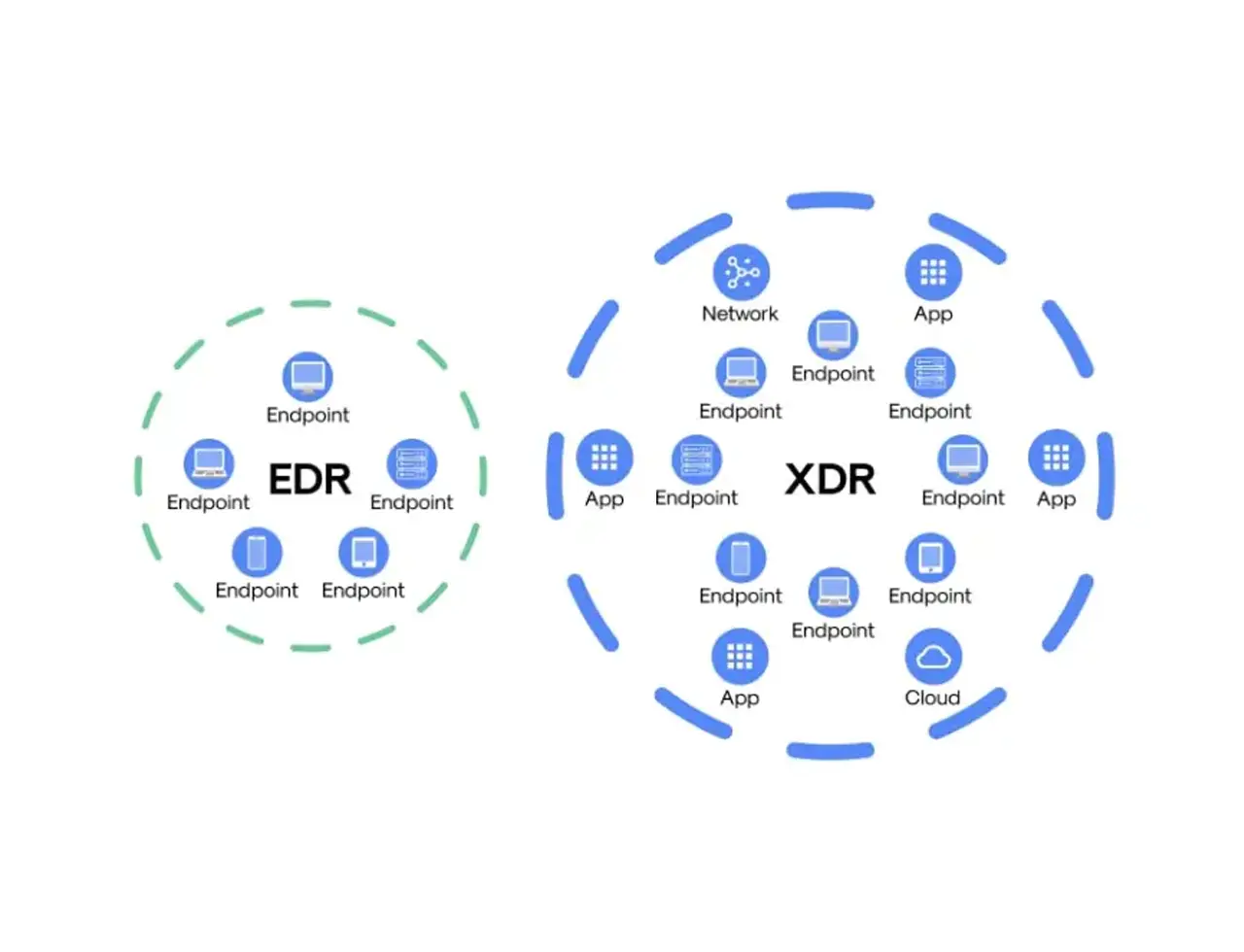
In today’s threat landscape, the EDR vs. XDR debate is a critical strategic decision for every organization.
Endpoint Detection and Response (EDR) was once the gold standard, but sophisticated cyberattacks targeting cloud, identities, and supply chains have made it insufficient on its own.
This guide will break down the key differences between EDR and Extended Detection and Response (XDR) to help you build a more resilient security posture.
Endpoint Detection and Response (EDR) was once the gold standard, but sophisticated cyberattacks targeting cloud, identities, and supply chains have made it insufficient on its own.
This guide will break down the key differences between EDR and Extended Detection and Response (XDR) to help you build a more resilient security posture.
Why EDR Alone Is No Longer Enough
EDR excels at detecting malware and suspicious activity on endpoints like laptops and servers.
However, modern attackers operate beyond the endpoint, using techniques that often bypass these traditional defenses.
However, modern attackers operate beyond the endpoint, using techniques that often bypass these traditional defenses.
Recent data underscores this evolution:
• 22% of breaches began with stolen credentials (2025 Verizon DBIR).
• Valid account abuse accounts for 30% of security incidents (IBM X-Force).
• Fileless malware and supply chain attacks are rising, evading endpoint defenses entirely (ENISA Threat Landscape 2024).
• Valid account abuse accounts for 30% of security incidents (IBM X-Force).
• Fileless malware and supply chain attacks are rising, evading endpoint defenses entirely (ENISA Threat Landscape 2024).
Compounding this, IT environments are more complex than ever.
Organizations now use an average of 106 SaaS applications
(BetterCloud’s 2025 State of SaaS Report), leading to SaaS sprawl, Shadow IT, and increased security blind spots.
EDR vs. XDR: Key Differences Explained
The core difference lies in focus and integration. EDR offers depth on endpoints, while XDR provides breadth across your entire digital environment.
| Feature | EDR (Endpoint Detection and Response) | XDR (Extended Detection and Response) |
| Focus | Endpoint-centric | Cross-domain (endpoint, cloud, identity, network, email) |
| Visibility | Device-level | Environment-wide |
| Correlation | Manual or limited | Automated, AI-driven correlation |
| Response | Endpoint-specific | Orchestrated response across systems |
| Primary Use Case | Detecting endpoint malware & suspicious behavior | Investigating & stopping complex, multi-stage attacks |
The Critical Role of EDR in a Post-Breach World
While XDR is essential for proactive, cross-domain detection, EDR remains the cornerstone of post-incident forensics.
After a breach, EDR provides the granular endpoint visibility needed for root cause analysis.
It answers critical questions: How did the threat enter? What did it execute?
Which systems were affected? This depth is irreplaceable for learning from an incident and strengthening your defenses.
After a breach, EDR provides the granular endpoint visibility needed for root cause analysis.
It answers critical questions: How did the threat enter? What did it execute?
Which systems were affected? This depth is irreplaceable for learning from an incident and strengthening your defenses.
Think of it this way: EDR is your foundation. XDR is your overarching strategy.
Actionable Steps to Bridge the Gap
You don’t need a massive budget to start building cyber resilience. Here’s how to begin:
1. Unify Your Existing Tools: Integrate your EDR, email security, and identity providers for immediate visibility gains.
2. Prioritize Identity Security: Implement MFA, conditional access, and behavioral monitoring—these are high-impact, cost-effective measures.
3. Automate Common Playbooks: Speed is critical. Automate response for known attack patterns.
4. Consider Managed Services: Leverage Managed Detection and Response (MDR) or Managed XDR services to get enterprise-level security without building an in-house SOC.
EDR vs. XDR: The Final Verdict
The future of cybersecurity is defined by integration, intelligence, and identity-first design.
EDR is your essential foundation for endpoint protection and deep forensic investigation.
XDR is the strategic evolution needed to correlate threats across your entire environment and automate response.
Cyber resilience—not just prevention—is the ultimate outcome.
EDR is your essential foundation for endpoint protection and deep forensic investigation.
XDR is the strategic evolution needed to correlate threats across your entire environment and automate response.
Cyber resilience—not just prevention—is the ultimate outcome.
Ready to Evolve Your Security Strategy?
If you’re still relying solely on EDR, your organization may be exposed to modern, multi-vector threats.
Speak to one of our security specialists for a free consultation. We’ll help you identify gaps in your security portfolio and build a layered defense strategy tailored to your needs.
Speak to one of our security specialists for a free consultation. We’ll help you identify gaps in your security portfolio and build a layered defense strategy tailored to your needs.